
How to Start a Business in the USA: 7 Steps Every New Entrepreneur Should Know
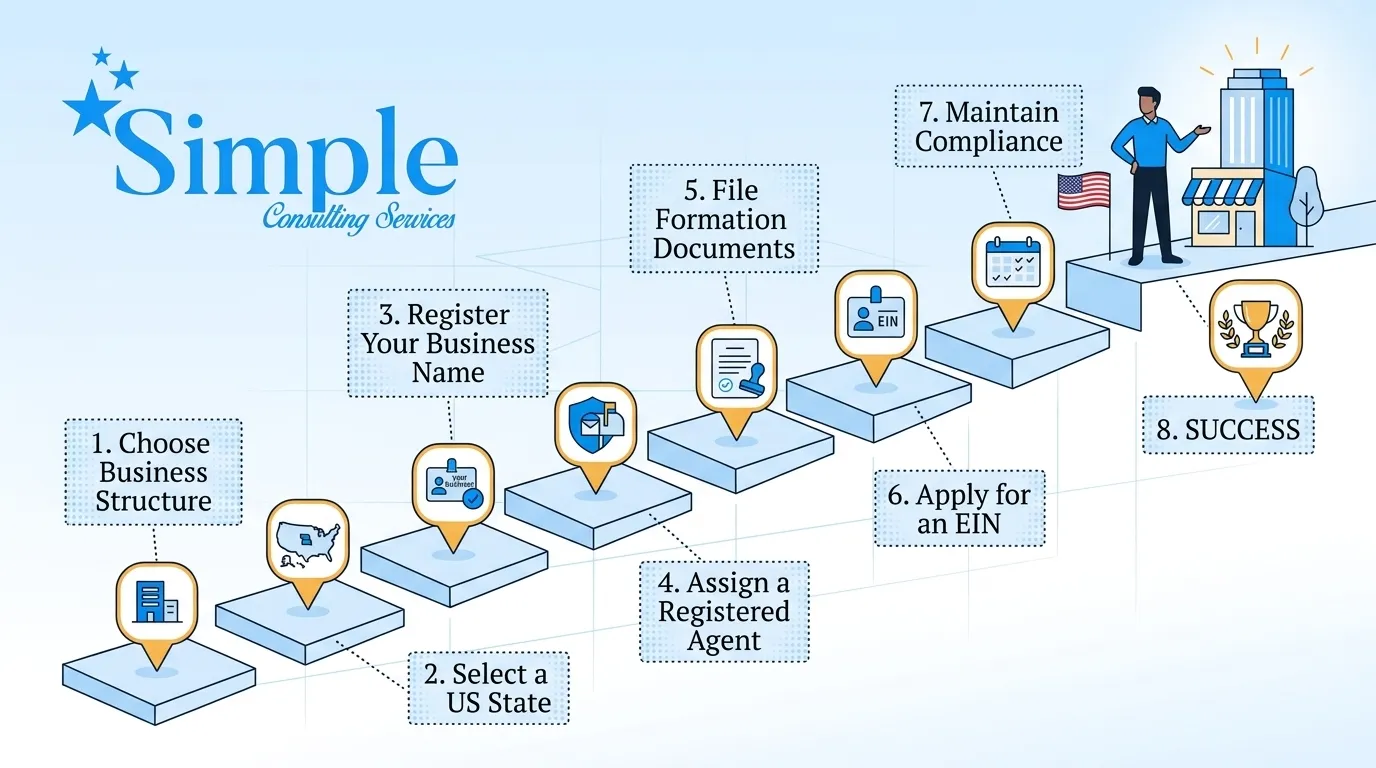
The 7 legal steps to start a business in the USA.
To start a business in the USA, choose a business structure (most small businesses pick an LLC), pick a state, confirm your name is available, appoint a registered agent, file formation documents with the state, get an EIN from the IRS, and keep up with annual filings. US citizenship is not required, and non-residents can complete every step remotely.
At a Glance
| Question | Short Answer |
|---|---|
| Do I need to be a US citizen? | No. Anyone can own 100% of a US LLC or corporation. |
| Can I do it remotely? | Yes. Formation, EIN, and many bank applications can be completed from abroad. |
| Most popular structure | LLC (limited liability company) |
| State filing fees | About $50 to $500 to form, depending on the state |
| EIN cost | Free from the IRS |
| Typical timeline | 1 to 3 weeks for US residents; 3 to 8 weeks for non-residents (the EIN is the slow step) |
| Does a US company give me a visa? | No. Owning a US company does not grant a visa or residency. |
Key Takeaways
- An LLC is the right starting point for most founders. It protects personal assets and keeps paperwork light.
- Your state choice has long-term costs. If you form in one state but operate in another, you usually have to register and pay fees in both.
- Everything else waits on the EIN: banking, Stripe, PayPal, payroll, and tax filings.
- Most US-created companies no longer file BOI reports with FinCEN, but foreign-owned LLCs have their own IRS filing (Form 5472) with a $25,000 penalty for missing it.
- Registered is not the same as operational. You still need a bank account, bookkeeping, and a way for customers to find you.
Who This Guide Is For
The legal steps are the same for everyone. What changes is how you get through them.
US Citizens and Residents
If you live in the US, your path is the simplest. You will usually form your company in your home state, get your EIN online in minutes, and open a bank account at a local branch. Your main decisions are the structure and how you want to be taxed.
Non-US Residents and International Founders
If you live outside the US, you can still own 100% of a US company. You do not need a Social Security Number, a visa, or a US home address. The differences show up in three places: how you get your EIN, which banks will accept you, and which IRS forms you must file every year. This guide flags each one as it comes up.
Important: Forming a US company is a business decision, not an immigration route. It does not give you the right to live or work in the United States. For visa questions, speak with an immigration attorney.
The 7 Legal Steps to Start a Business in the USA
These steps create your company and make it legal to operate.
Step 1: Choose a Business Structure
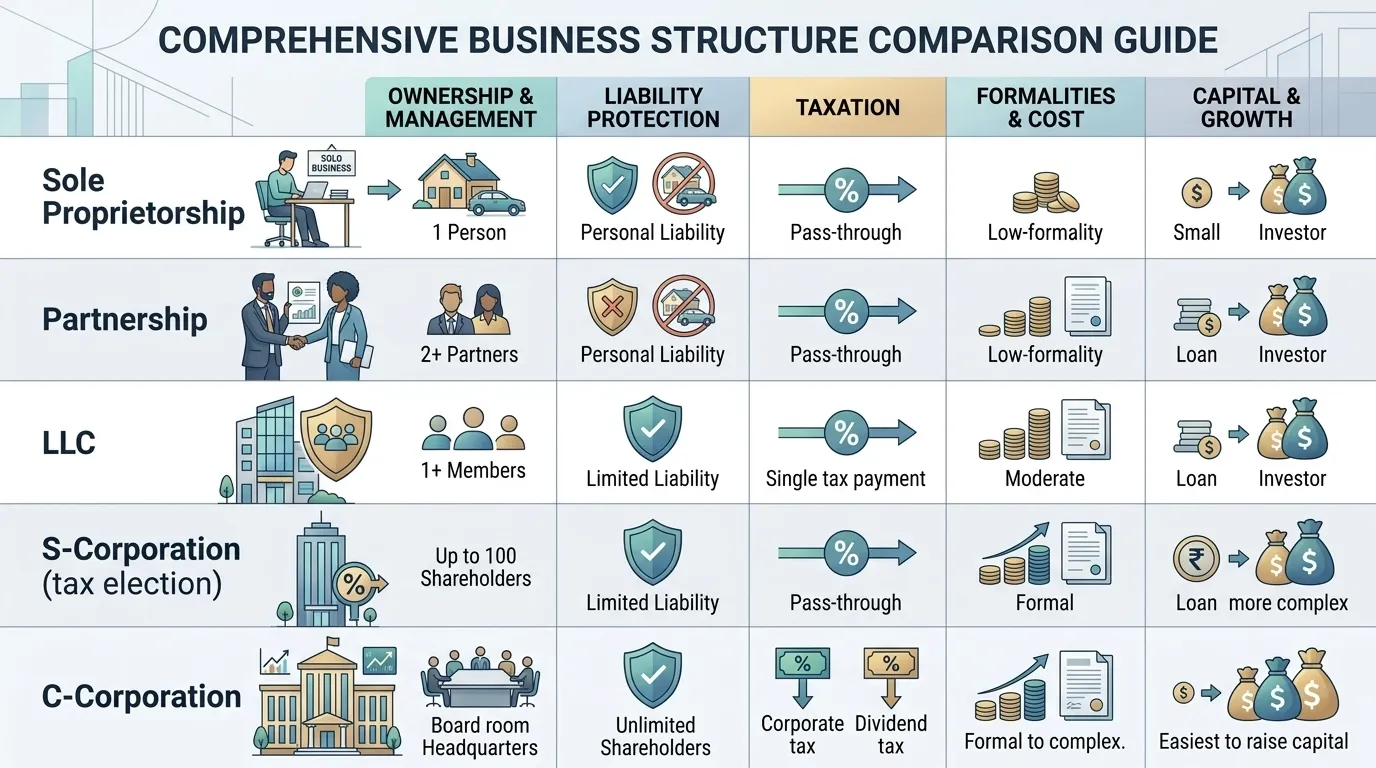
Your structure decides three things: whether your personal assets are protected, how your profits are taxed, and how much paperwork you handle each year.
| Structure | Personal Liability Protection | How It's Taxed | Paperwork | Best For |
|---|---|---|---|---|
| Sole Proprietorship | None | On your personal return | Very low | Testing an idea with low risk |
| Partnership | None (general partnership) | Passes through to partners | Low | Two or more owners with a written agreement |
| LLC | Yes | Pass-through by default; can elect S-Corp or C-Corp tax | Low to moderate | Most small businesses, freelancers, ecommerce, non-resident founders |
| S-Corporation (tax election) | Yes | Pass-through, with possible payroll tax savings | Moderate (payroll required) | Profitable US-owned businesses |
| C-Corporation | Yes | Corporate tax, then tax on dividends | Higher | Startups raising investment, planning to issue stock |
When an S-Corp Election Makes Sense
An S-Corp is not a separate entity. It is a tax election that an LLC or corporation makes with the IRS. Once profits are high enough, paying yourself a reasonable salary plus distributions can reduce self-employment tax. S-Corp shareholders must be US citizens or residents, so non-residents cannot use this option.
When a C-Corp Is the Better Choice
Investors and venture funds usually require a C-Corporation (often formed in Delaware) because shares are easy to issue and transfer. A C-Corp is also a common choice for non-residents who want to keep profits inside the company rather than have them pass through.
Common mistake: Picking a structure based only on what a friend used. The right choice depends on your tax residency, who your owners are, and whether you plan to raise money.
How Simple Consulting Services Helps
Our specialists review your goals, ownership, and tax residency, then recommend the structure that fits. Because our team also handles S-Corp tax filing, C-Corp tax filing, and partnership tax filing, the structure we set up is the one we file for, with no hand-off gaps.
Step 2: Choose Your State
Every state has its own fees, annual requirements, and privacy rules. The cheapest state to form in is not always the cheapest state to stay in.
The Foreign Qualification Trap
This is the mistake that costs founders the most. If you form an LLC in Wyoming but have an office, employees, or a physical location in California, the law treats you as "doing business" in California. You must then register your LLC there as a foreign LLC and pay California's fees, including its $800 minimum annual franchise tax. You end up paying two states instead of one.
Rule of thumb: if you have a physical presence in a state, form there. Out-of-state formation mainly helps founders who have no physical presence in any state.
State Comparison
| State | LLC Formation Fee | Ongoing State Cost | Known For |
|---|---|---|---|
| New Mexico | $50 | $0 (no annual report) | Lowest upkeep, owner privacy |
| Wyoming | $100 | $60 minimum annual report | Low cost, popular with non-residents |
| Delaware | $110 | $300 annual LLC tax (due June 1) | Investor-friendly corporate law |
| Florida | $125 | $138.75 annual report | No state personal income tax |
| Texas | $300 | No franchise tax for most small LLCs (an annual report is still filed) | No state personal income tax |
| Nevada | $425 (includes initial list and state business license) | $350 per year | No state income tax, higher fees |
| California | $70 | $800 minimum franchise tax | Required if you operate in California |
State fees as of October 2026. States change fees, so confirm the current amount with the Secretary of State before filing. Registered agent fees are not included.
How Simple Consulting Services Helps
We look at where you live, where your customers are, and how you will sell, then recommend the state that keeps your total cost lowest over time, not just on day one. Learn more about our LLC registration in the USA service.
Step 3: Choose a Business Name
Run a Business Entity Search
Each Secretary of State has a searchable database of registered businesses (Florida's is called Sunbiz, for example). Your name must be clearly different from existing companies in that state, or the filing will be rejected.
Follow the Naming Rules
- LLCs must include "LLC," "L.L.C.," or "Limited Liability Company."
- Corporations must include "Inc.," "Corp.," "Corporation," or similar.
- Words like "Bank," "Insurance," or "University" usually need extra approval.
DBA (Doing Business As) Names
If you want to trade under a brand name that differs from your legal name, you can register a DBA (also called a fictitious or assumed name). One LLC can run several brands this way.
Check the Domain and Trademark Before You File
A state name registration does not stop another company from using your name in other states. A federal trademark gives you nationwide protection. Check the domain at the same time, because renaming a business after launch is expensive.
How Simple Consulting Services Helps
We run the entity search, confirm the domain is available, and can file your trademark registration. When you're ready, the same team builds your site through our website development service.
Step 4: Appoint a Registered Agent
Your registered agent must be available at a physical street address (not a P.O. box) during normal business hours. If your company is sued, the court papers go to the agent. If state notices are missed, your company can fall out of good standing.
Can You Be Your Own Registered Agent?
You can if you live in the formation state and are reliably available at that address. Most founders still use a professional agent because:
- Your address becomes public record.
- You must be present during business hours.
- Non-residents and founders forming out of state have no in-state address, so they need a professional agent.
How Simple Consulting Services Helps
Registered agent service is part of our LLC setup, so your legal mail is handled and forwarded from day one.
Step 5: File Your Formation Documents
What the Filing Includes
- Business name and principal address
- Registered agent name and address
- Management type (member-managed or manager-managed for LLCs)
- Organizer or incorporator details
- Business purpose (often a general statement)
Draft an Operating Agreement
Most states don't require you to file an operating agreement, but you need one. It sets out ownership percentages, how decisions are made, and what happens if an owner leaves. Banks routinely ask for it when you open a business account, and it supports your liability protection.
Processing Times
Online filings in many states are approved within a few business days. Paper filings and busy periods can take several weeks. Most states offer expedited processing for an added fee.
Common mistake: Skipping the operating agreement because the state didn't ask for it. Without one, the bank application stalls and owner disputes have no written rules to settle them.
How Simple Consulting Services Helps
A human specialist prepares and files your formation documents and drafts your operating agreement, then tracks the filing until the state approves it. You never have to decode a Secretary of State portal.
Step 6: Apply for an EIN
You need an EIN to open a business bank account, connect Stripe or PayPal, hire employees, and file business tax returns. Without it, your company exists on paper but cannot move money.
US Residents: Apply Online
If the responsible party has a Social Security Number or ITIN, the IRS online application issues the EIN immediately during business hours.
Non-Residents: Getting an EIN Without an SSN
The IRS online tool only works for applicants who already have an SSN or ITIN. Non-residents complete Form SS-4 and submit it by:
- Fax: usually the fastest written option, often around a week when a return fax number is included
- Mail: the slowest option, often four weeks or more
- Phone: international applicants can call the IRS and receive the EIN during the call
You do not need an SSN or ITIN to get an EIN for your company.
EIN vs. ITIN: Which One Do You Need?
| EIN | ITIN | |
|---|---|---|
| Who it identifies | Your business | You, as an individual |
| Needed for | Bank accounts, payment processors, business tax returns, payroll | Your own US personal tax return; some banks and payment providers |
| How to get it | Form SS-4 (or online for SSN/ITIN holders) | Form W-7, usually filed with a tax return |
| Order | Get it first, right after formation | Only if you actually need it |
Good to know: The IRS never charges for an EIN. When you use a service, you are paying for correct preparation, submission, and follow-up, which matters because an error on Form SS-4 can delay your bank account by weeks.
How Simple Consulting Services Helps
We prepare and submit your SS-4 and follow up with the IRS until your EIN is issued. If you also need an individual tax ID, our ITIN service handles the W-7 process. See our EIN service for details.
Step 7: Understand Ongoing Requirements
State Annual Reports and Franchise Taxes
Most states require an annual or biennial report with a fee. Some, like Delaware and California, charge a flat annual tax. Missing these can lead to late fees and, eventually, administrative dissolution of your company.
BOI Reporting in 2026: What Changed
The Corporate Transparency Act originally required almost every LLC to report its owners to FinCEN. That changed in March 2025, and a 2026 final rule made it permanent: companies created in the United States are exempt from BOI reporting, even if all their owners are foreign nationals. Only foreign companies registered to do business in the US still file. FinCEN never charges a filing fee, so treat any "BOI filing fee" email as a scam.
Federal Tax Returns by Entity Type
- Single-member LLC (US owner): reported on the owner's personal return (Schedule C)
- Multi-member LLC or partnership: Form 1065, plus a K-1 for each partner
- S-Corp: Form 1120-S
- C-Corp: Form 1120
Form 5472 for Foreign-Owned Single-Member LLCs
If a non-US person owns a single-member LLC, the LLC must file Form 5472 with a pro forma Form 1120 for every year with a reportable transaction, such as you putting money in or taking money out. This applies even when the company owes no US tax. The penalty for not filing is $25,000. This is the most commonly missed filing for international founders.
Sales and Use Tax
If you sell taxable products or services, you may need to register and collect sales tax in states where you have "nexus." Nexus can come from a physical presence or from crossing a state's sales threshold (economic nexus), even with no office there. Ecommerce sellers often owe in several states.
Business Licenses and Permits
Requirements depend on your industry and location. You may need a state business license, a city or county license, and industry permits (food, health, construction, professional services). Check with your city and county as well as the state.
Compliance Calendar
| Filing | Who It Applies To | How Often | Typical Timing |
|---|---|---|---|
| State annual report or tax | Most LLCs and corporations | Yearly or every 2 years | Varies by state (Delaware LLCs: June 1) |
| Form 1065 / 1120-S | Partnerships, multi-member LLCs, S-Corps | Yearly | March 15 (calendar year) |
| Form 1120 | C-Corps | Yearly | April 15 (calendar year) |
| Form 5472 + pro forma 1120 | Foreign-owned single-member LLCs | Yearly | April 15 (extension available) |
| Sales and use tax returns | Sellers with nexus | Monthly, quarterly, or yearly | Set by each state |
| Payroll tax filings | Businesses with employees | Quarterly and yearly | Federal Form 941 each quarter |
| BOI report | Foreign companies registered in the US only | When formed or changed | Not required for US-created companies |
How Simple Consulting Services Helps
We track your deadlines and handle the filings, from business tax preparation to sales and use tax filing. If you've already missed a deadline, our penalty abatement team can request relief from the IRS.
From Registered to Operational
Your company now exists. These steps make it ready to take payments, stay organized, and win customers.
Step 8: Open a US Business Bank Account
Documents Banks Usually Ask For
- Articles of Organization or Incorporation (state-approved)
- EIN confirmation letter from the IRS (CP 575 or 147C)
- Operating agreement or bylaws
- Valid passport or government ID for each owner
- A US business address (some banks won't accept a registered agent address alone)
- A short description of what your business does and where customers are
Traditional Banks vs. Online Business Banks
Traditional banks often prefer an in-person visit, which can be difficult for non-residents. Many online business banking platforms accept non-resident LLC owners remotely with just an EIN and passport. Requirements change often, so check each bank's current rules before applying.
Connect Your Payment Processor
Once your account is open, connect it to Stripe, PayPal, or your ecommerce platform using your company's EIN. This is when your business can start accepting payments in US dollars.
Common mistake: Applying to banks before the EIN arrives. The application is rejected or put on hold, and some banks make you wait before reapplying.
How Simple Consulting Services Helps
We prepare a bank-ready document package and support your application, so it goes in complete the first time.
Step 9: Set Up Bookkeeping, Payroll, and Hiring Compliance
QuickBooks or Xero?
Both are reliable. QuickBooks is the most widely used by US accountants and has strong payroll features. Xero is popular with international founders and handles multiple currencies well. The best choice is the one your bookkeeper and tax preparer work in every day.
When You Need Payroll
You need payroll as soon as you hire employees, or as soon as an S-Corp owner starts taking a salary. Payroll covers withholding, tax deposits, quarterly filings, and year-end W-2s.
E-Verify for New Hires
E-Verify confirms that new employees are authorized to work in the US. It is required for federal contractors and by several states for some or all employers.
How Simple Consulting Services Helps
We configure QuickBooks or Xero and keep your books clean every month through our bookkeeping services. Our team also runs payroll and E-Verify, so your first hire goes smoothly.
Step 10: Build Your Online Presence and Start Getting Customers
Your Website
A clear, fast website builds trust with customers, and with banks and payment processors that review it during approval. Service businesses usually do best on WordPress. Product businesses usually do best on Shopify.
Getting Found: SEO and AI Search
Customers now search on Google and ask AI assistants like ChatGPT and Gemini for recommendations. Search engine optimization helps you rank. AI search optimization helps your business appear when those assistants answer questions in your industry.
Your First Leads
Paid search ads bring traffic quickly while SEO builds over time. Social media keeps your brand visible. A CRM like HubSpot keeps every inquiry, follow-up, and deal in one place.
How Simple Consulting Services Helps
Our human specialists build your site through website development, then drive traffic with SEO services, AI search optimization, PPC advertising, social media marketing, and lead generation.
Starting a US Business as a Non-Resident: Complete Checklist
Non-residents follow the same steps, but the order matters more because each step waits on the one before it.
What You Need Before You Start
- Valid passport
- Your home address abroad
- Your company name, plus two backup options
- A short description of what the business will do
- Owner names and ownership percentages
The Right Order
- Choose your structure and state
- Appoint a registered agent in that state
- File your formation documents and sign your operating agreement
- Apply for your EIN with Form SS-4
- Open your US business bank account
- Connect Stripe, PayPal, or your sales platform
- Set up bookkeeping from the first transaction
- Apply for an ITIN only if you need one
- File Form 5472 every year (single-member LLCs)
What You Do NOT Need
- A Social Security Number
- A US visa or Green Card
- A US home address
- A trip to the United States (for most remote banking options)
How Much Does It Cost to Start a Business in the USA?
Your actual cost depends on the state, structure, and how much of the setup you want handled for you. Here is what to budget for in year one.
| Item | Typical Cost | One-Time or Recurring |
|---|---|---|
| State formation fee | $50 to $500 | One-time |
| Registered agent | About $50 to $300 per year | Recurring |
| EIN | Free from the IRS | One-time |
| Operating agreement | $0 (template) to several hundred dollars (custom) | One-time |
| Business licenses and permits | $0 to several hundred dollars | Often recurring |
| State annual report or tax | $0 to $800+ | Recurring |
| Accounting software | Monthly subscription | Recurring |
| Website, domain, and hosting | Varies by scope | Mixed |
DIY vs. working with us: Doing it yourself saves the service fee but costs time, and errors cost more. A rejected filing, a wrong answer on Form SS-4, or a missed Form 5472 can easily cost more than professional setup. Our pricing sits at or below market for comparable service, and setup includes the pieces most formation companies leave out, like bank support and bookkeeping configuration.
How Long Does It Take?
Here is a realistic timeline from first call to taking payments.
- Days 1 to 3: Structure and state decided, name checked, registered agent appointed
- Days 3 to 10: Formation documents filed and approved (faster with expedited filing)
- Same day to 1 week after approval: EIN issued for US residents (online) and for non-residents applying by phone
- 1 to 4+ weeks after approval: EIN issued for non-residents applying by fax or mail
- 1 to 2 weeks after EIN: Bank account opened and payment processor connected
- Ongoing from week 1: Bookkeeping set up, website built, marketing launched
For most US residents, the full setup takes 1 to 3 weeks. For non-residents, plan on 3 to 8 weeks.
7 Common Mistakes New Founders Make
- Forming in the "cheap" state while operating in another. You end up registered and paying fees in both.
- Skipping the operating agreement. Banks ask for it, and owner disputes have no rules to fall back on.
- Applying to banks before the EIN is issued. The application stalls or gets rejected.
- Mixing personal and business money. This weakens your liability protection and makes tax time harder.
- Missing Form 5472. Foreign-owned single-member LLCs face a $25,000 penalty even when no tax is due.
- Ignoring sales tax nexus. Online sellers can owe sales tax in states where they have no office.
- Waiting too long to build a website. Banks, payment processors, and customers all check it.
DIY vs. Hiring an End-to-End Partner
| Do It Yourself | Formation-Only Service | End-to-End Partner | |
|---|---|---|---|
| Time you spend | High | Medium | Low |
| Risk of filing errors | Highest | Medium | Lowest |
| Number of vendors | Many | Several | One |
| Bank and payment setup | On your own | Rarely included | Included |
| Bookkeeping and tax | Separate hire | Separate hire | Same team |
| Website and marketing | Separate hire | Separate hire | Same team |
| Who you call when something breaks | Nobody | A support queue | Your dedicated point of contact |
How Simple Consulting Services Takes You From Idea to Operating Business
Most founders don't need five different vendors. They need one partner who sees the full picture. Simple Consulting Services gives you a single point of contact and a dedicated team of human specialists for every stage, from your first filing to your first customer. All of our client work is 100% human-crafted.
Business Setup
LLC registration, EIN, ITIN, registered agent, trademark, E-Verify, and LLC dissolution.
Finance and Tax
Bookkeeping in QuickBooks or Xero, payroll, business and individual tax prep, sales tax, and penalty abatement.
Tech and Web
WordPress and Shopify websites, payment setup, and HubSpot CRM.
Marketing
SEO, AI search optimization, PPC, social media, and lead generation.
Ready to Start Your US Business?
Book a free consultation. A specialist will review your plan, recommend the right structure and state, and map out every step from formation to your first sale.
Book a Free ConsultationCall +1 (929) 924-9287 · Email info@simpleconsultingservices.net
Palora Ave, Yuba City, California
Frequently Asked Questions
Can a non-US citizen start a business in the USA?
Yes. There is no citizenship or residency requirement to own a US LLC or corporation. Non-residents can own 100% of the company, form it remotely, get an EIN without an SSN, and open a US business bank account. Owning a company does not, however, give you a visa or the right to work in the US.
What is the easiest type of business to start in the USA?
A sole proprietorship needs the least paperwork, but it offers no protection for your personal assets. For most founders, a single-member LLC is the best balance: it is simple to form, inexpensive to maintain, and separates business debts and lawsuits from your personal savings and property.
Which state is best to form an LLC?
If you have a physical presence in one state, form your LLC there to avoid paying fees in two states. Non-residents with no US presence often choose Wyoming or New Mexico for low fees and simple upkeep, or Delaware if they plan to raise investment or convert to a corporation later.
How much does it cost to start an LLC?
State formation fees range from about $50 in New Mexico to $425 in Nevada. Add a registered agent (often $50 to $300 per year), any required licenses, and your state's annual report or tax. The EIN is free from the IRS. Total first-year cost depends mostly on the state you choose.
Do I need an SSN to get an EIN?
No. Non-residents without an SSN or ITIN can get an EIN by submitting IRS Form SS-4 by fax or mail, or by calling the IRS as an international applicant. The only limitation is that the instant online application is reserved for people who already have an SSN or ITIN.
Do I need an ITIN to open a US business bank account?
Usually not. Most banks identify your business by its EIN, and many accept a passport for owner verification. Some banks and payment providers do ask for an ITIN, and you may need one to file a personal US tax return. Get your EIN first and apply for an ITIN only if a specific need comes up.
Do I need to file a BOI report in 2026?
Not if your company was created in the United States. FinCEN exempted all US-created companies in March 2025 and made that permanent in a 2026 final rule, even when the owners are foreign nationals. Only companies formed outside the US and registered to do business here still file BOI reports.
What is Form 5472, and does it apply to me?
Form 5472 is an IRS information return. A single-member LLC owned by a non-US person must file it, along with a pro forma Form 1120, for any year with a reportable transaction, such as the owner adding or withdrawing money. It applies even with no US tax due, and the penalty for missing it is $25,000.
Can I be my own registered agent?
Yes, if you live in the state where your company is formed and can be reached at a physical address during business hours. Your address will become public record. Non-residents and anyone forming in a different state from where they live must use a professional registered agent.
How long does it take to start a business in the USA?
US residents can usually form a company, get an EIN, and open a bank account within 1 to 3 weeks. Non-residents should plan on 3 to 8 weeks, mainly because the EIN takes longer without an SSN. Expedited state filing and applying for the EIN by phone can shorten the timeline.
Do I need a business license?
Most businesses need at least one license, but requirements vary by state, city, county, and industry. Some states, like Nevada, require a statewide business license for nearly every company. Regulated fields such as food, healthcare, construction, and finance need additional permits. Check state and local requirements before you start operating.
Can I run a US LLC from outside the United States?
Yes. Many founders manage US LLCs entirely from abroad using a registered agent, an online business bank account, and US payment processors. You must keep up with state filings and IRS requirements, including Form 5472 for foreign-owned single-member LLCs, and you may owe US tax if the LLC has US-connected income.
References
- U.S. Small Business Administration: Launch Your Business
- IRS: Get an Employer Identification Number
- IRS: About Form SS-4
- IRS: About Form 5472
- IRS: About Form W-7 (ITIN)
- FinCEN: Beneficial Ownership Information
Legal and Tax Disclaimer: Simple Consulting Services provides administrative support, document preparation, compliance management, and strategic planning for business formation, tax, and bookkeeping matters. We do not provide legal counsel or certified public accountant (CPA) advice. Where a legal opinion or CPA sign-off is required, we work with licensed partners. Fees, deadlines, and rules described in this article were accurate when published and may change. Confirm current requirements with the relevant state agency or the IRS before acting.